


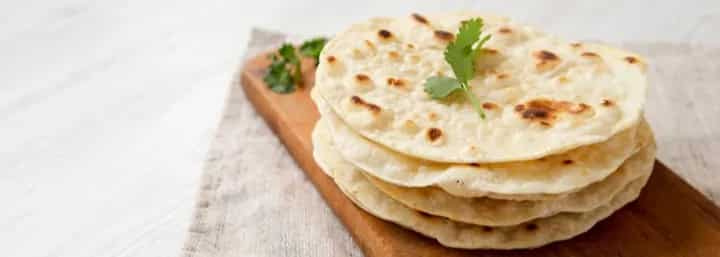
Roti
Nutritional Value
1927
Calories
per serving
- Fat38 g
- Protein69 g
- Carbs320 g
- Fiber39 g
- Sodium0 g
- Others0 g
- Place of OriginEGYPT,,INDUS,VALLEY
- CuisineAsian,Indian,Middle Eastern,African
- Common Ingredients
- CourseMain Course,Staple
An accompaniment to several dishes and curries, Roti, also known as Chapati, is a humble and comforting staple consumed across India and several other South Asian countries and even in parts of Eastern Africa. It is a flatbread, given the shape of a thin disc using a rolling pin, typically made with wheat flour which has been kneaded to form a dough and then roasted on a thin griddle or tawa till it puffs up. Etymologically, the term roti has been derived from the Sanskrit word rotika which meant bread. It is also known as chapati, rotli, ruti, safati, shabaati, phulka, chapo and roshi.
The history of the origin of Roti however has contesting opinions. While some believe it to have ancient Egyptian origins brought to India, others claim it to be present in the subcontinent from the times of the Indus Valley Civilization some thousand of years ago. Wheat was a common grain cultivated since ancient times and numerous pieces of evidence of it have been excavated in the sites of Mohenjo-Daro. A variant of the modern-day atta or wheat flour indicates the presence of roti or similar hand-made bread that has been a part of the daily diet during the Indus Valley Civilization.
Mention of the Roti is believed to be found in the writings of Baba Farid Ji in 12th century, 15th century Sikh religious scripture, Guru Granth Sahib, also records this iconic staple. Even the 16th-century text, Ain-i-Akbari, by Abul Fazl, documents the Roti as Emperor Akbar’s favourite. Later, travellers and merchants are credited to have popularised the Roti to different parts of the world. It became a much sort after food especially among the British during the Independence War of 1857, where the soldiers were served Roti.
With culinary experimentations over the years, the Roti has seen numerous variations, be it the ingredient used or the method followed. In certain areas, atta or wheat flour has been replaced by ingredients like jowar, bajra, makki or chawal. Different types of flatbreads include Tandoori Roti (made in a Tandoor or clay oven), Rumali Roti (referring to rumal or handkerchief), and Roti Canai (a type of paratha). Recent innovations in readymade Rotis, be it frozen or sold over the counter have made this staple accessible to the working middle-class without the hassle of making it..
Nutritional Value
1927
Calories
per serving
- Fat38 g
- Protein69 g
- Carbs320 g
- Fiber39 g
- Sodium0 g
- Others0 g