


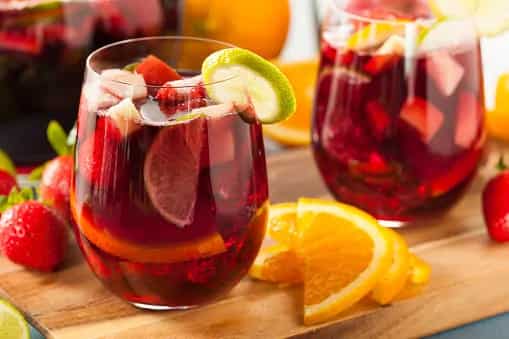
Red Wine Sangria
Nutritional Value
192
Calories
per serving
- Fat1 g
- Protein0 g
- Carbs21 g
- Fiber0 g
- Sodium0 g
- Others0 g
- Place of OriginSPAIN
- CuisineSpanish
- Common Ingredients
- CourseStarter & Appetizer
A globally famed wine-based cocktail, Sangria has its roots in Spain and is a raging hit among summer and fall partygoers. Backed by an illustrious narrative, this favoured wine cooler offers enough regional variations to suit everyone's palates, even the most finicky ones. Essentially, the literal meaning of "Sangria" is "bloodletting" in Spanish and Portuguese. Thus, it is safe to say that the drink got its name from its crimson hue, owing to the red wine used.
Tracing one of the popular accounts of Sangria's history leads to 200 BC when the Romans swept through Spain. As the saying goes, they were the ones to plant vineyards in the region, which paved the way for a flourishing wine shipping trade. A century later, Sangria became a go-to European drink, with a base of French Bordeaux. In the 1700s and 1800s, even the British and the French were noted to be experimenting with this ruby concoction.
Sangria's origin story also dates back to a time when water was considered unsafe to drink, because of its unfiltered usage. During this era, fermented drinks were credited with a much lower risk of causing health issues. Therefore, people would drink wine more often, combined with various spices such as cinnamon, nutmeg, and clove alongside fruits, including oranges, apples and pomegranates.
Over the years, Sangria has grown to become a refreshing party beverage worldwide. The classic version uses wine made from Tempranillo, the grape responsible for the famous red wines of Spain's Rioja territory. Nevertheless, not all red wines can replicate the original taste of Sangria or be anywhere close to it, due to their specific notes.
To put together a delicious pitcher of Sangria, dry red wines that offer fruity notes and aromas should be picked. Older red wines are a little too delicate to be mixed with other ingredients, so they are not the ideal choice. After adding chopped fruits and soda water to the red wine, it is advised to chill the mixture overnight so that the flavours of the fruits can infuse into the drink. Further, liquors like rum, vodka, triple sec, cognac or Cointreau can also be blended to make the Sangria stronger.
A glass of red Sangria can be paired well with a serving of tender steak, a plate of hummus, a platter of aged cheese or any umami-rich nosh. In all, be it at a formal brunch with colleagues or a weekend at home with friends, one can never go wrong with a glass of Sangria!
Nutritional Value
192
Calories
per serving
- Fat1 g
- Protein0 g
- Carbs21 g
- Fiber0 g
- Sodium0 g
- Others0 g