


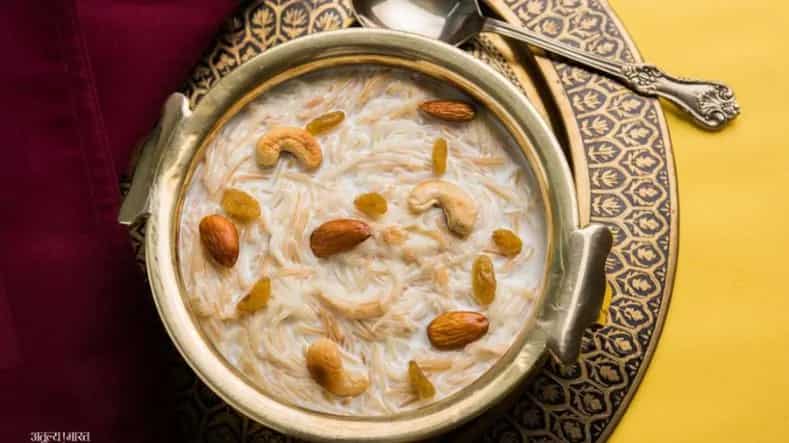
Semiya Payasam
Nutritional Value
1159
Calories
per serving
- Fat54 g
- Protein28 g
- Carbs137 g
- Fiber7 g
- Sodium0 g
- Others0 g
- Place of OriginSOUTH,INDIA
- CuisineSouth Indian
- Common Ingredients
- CourseDessert
Very few dishes in any cuisine around the globe can boast of a history spanning more than a millennium. In India, there is a dessert that finds equal love in every local culture and bears the legacy of the land’s historical as well as mythological past—the Payasam. Though the traditional way of cooking Payasam uses rice, a rather interesting conjunction is achieved by boiling milk with semiya, or seviya as it is called in the north, and garnishing with chopped cashew, raisins, pistachios, and saffron strands. The dish Semiya Payasam is sure to satiate the inherent Indian sweet tooth and leave a lasting aftertaste of sheer joy.
Called by many names —Payasam, Kheer, Payasa, or Payesh, it is the addition of the Indian vermicelli or semiya that lends the dish a distinctively altered texture than its more widespread forerunner, the rice pudding. While the traditional semiya is made from rice, other variants of the vermicelli employ wheat and ragi too.
The earliest references to the Semiya can be found in the Sangam literature of the 1st century CE. It is hard to pinpoint the exact course of vermicelli’s arrival on the Indian platter, but some refute the Tamil origin by suggesting that it was the historical travel of Marco Polo along the ancient Silk Route in the 13th century that helped the Chinese tradition of making vermicelli from buckwheat to pervade the Persian culture and henceforth the Indian subcontinent.
As for the Payasam, the beginnings are shrouded a degree further in cultural mysticism and mythological narratives. One story suggests that the dessert supreme originated in the temple town of Puri in Odisha 2,000 years ago and has ever since been a regular offering to the presiding deity Lord Jagannath.
Another perspective binds the history of the Payasam to Kerala by speculating that it was Lord Krishna who paved the way for this tempting dessert. Legend has it that Krishna, in the form of an old sage, challenged the arrogant King of Ambalapuzha to a game of chess under the condition that if he won, the king would have to pay him rice in geometric multiples of the number of grains previously placed. Having lost the game, the king started placing rice grains only to witness them growing exponentially. When left helpless to procure that much rice, Krishna revealed his identity to the visibly apologetic king and suggested he pay by serving bowls of Payasam instead to all pilgrims visiting the temple of Ambalapuzha.
Nutritional Value
1159
Calories
per serving
- Fat54 g
- Protein28 g
- Carbs137 g
- Fiber7 g
- Sodium0 g
- Others0 g