


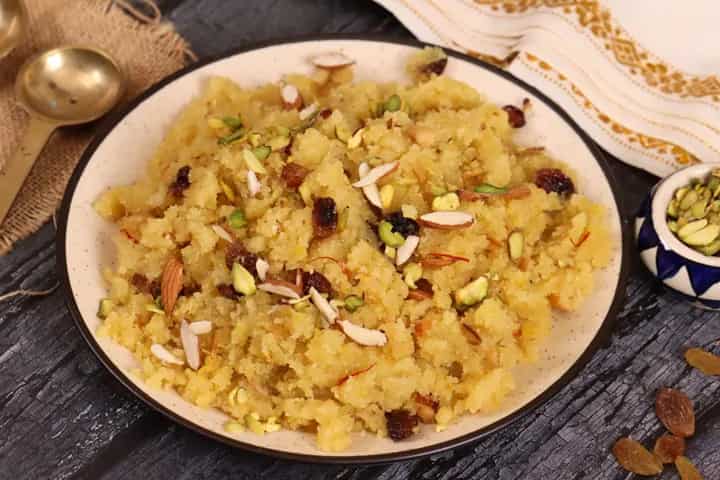
Malido
Nutritional Value
2553
Calories
per serving
- Fat118 g
- Protein61 g
- Carbs321 g
- Fiber36 g
- Sodium0 g
- Others0 g
- Place of OriginMAHARASHTRA
- CuisineAsian,Indian,Parsi
- Common Ingredients
- CourseDessert
The repertoire of Parsi cuisine is choc-a-block with savoury preparations of meat, eggs, rice, vegetables and fish. Comparatively, the choice for desserts are limited and are either heavily inspired by cakes and custards, or Indian desserts like Badam Barfi and Puran Poli.
But the one quintessentially Parsi dessert has to be Malido, a fudgy, sugary porridge traditionally served at the Fire Temple as a religious offering. Several historical accounts state that Malido was traditionally cooked by the priest’s wife and required immense culinary expertise to nail the consistency of a dense Halwa.
Much like the entirety of Parsi cuisine, Malido is also made by different cooks in different ways. But the most prevalent method of cooking Malido was a rather painstaking one as highlighted in Modern Parsi cookbooks.
After grinding wheat to form a coarse flour, it was kneaded together with ghee to form a crumbly dough. This dough was then used to make crispy, brown Rotla (flatbread) over a wood fire stove. After the Rotis became crispy, they were coarsely ground and mixed with sugar syrup until the mix begins to somewhat bind together.
As more and more Parsi households started making Malido, they kept on adding and subtracting ingredients to suit their liking. Modern versions of Malido use a combination of whole wheat and refined flour along with semolina to give the Halwa a grainy bite. Fried nuts and cashews can be used as a garnish. In terms of flavouring agents, from vanilla to cardamom to rose water, there is a world of options to select from. The most unique aspect of this porridge is that it uses a beaten egg to give body to the dish.
Since Malido has quite an overpowering sweet flavour, it is usually paired with a saltier Parsi flatbread named Paper.
Nutritional Value
2553
Calories
per serving
- Fat118 g
- Protein61 g
- Carbs321 g
- Fiber36 g
- Sodium0 g
- Others0 g