


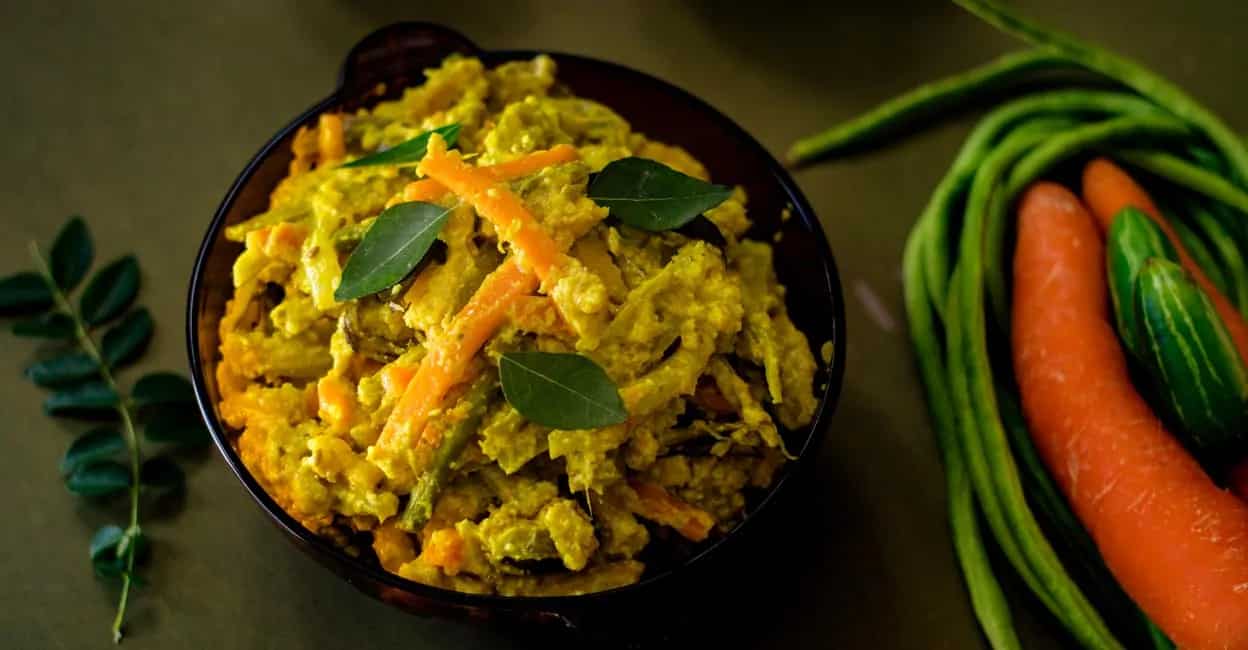
Avial
Nutritional Value
1199
Calories
per serving
- Fat76 g
- Protein27 g
- Carbs98 g
- Fiber56 g
- Sodium0 g
- Others0 g
- Place of OriginSOUTH,INDIA
- CuisineAsian,Indian,South Indian
- Common Ingredients
- CourseMain Course
The present age of holistic nutrition and organic sustenance has placed a special emphasis on the healthy way of eating, adequately discussed in ancient oral and aural literature. The Avial is one such culinary masterpiece that is the starting preparation for the Malayali Sadya, a customary feast palette for Onam. Traditionally a medley of locally and seasonally available vegetables, the Avial is widely popular as a signature South Indian delicacy that is lovely to taste, and wisely to consume. The dish can be made from the mixture of many local produce—plantain, elephant yam, string beans and Malabar cucumber, only to name a few. While coconut oil serves as the choice of grease for the stew, authentic Deccan spices and coconut shavings seem to be irreplaceable aspects of this delightful concoction.
The origin of this vastly popular dish is, however, often contested. One of the stories asserts that it was the mighty Pandava Bheema who invented the dish during the exile years in disguise. It is believed that Bheema took the garb of a cook named Vallabha in the kingdom of Virat. One day, when there was a shortage of ample vegetables to cook any standalone side dish, Bheema decided to julienne all the vegetables left in the kitchen and cook them together in a large iron vessel. He named the dish Avial.
Another variation of Avial’s origin links the dish to Kauravas’s attempt of murdering Bheema. It is said that after poisoning him, the Kauravas tied and downed Bheema. When the days of mourning were completed, and a funeral feast was organised in his memory, Bheema emerged from the water. The feast was no doubt cancelled but instead of wasting the ingredients, Bheema cooked all the vegetables together to make the Avial.
A third narrative links the dish to a legend more akin to its South Indian craze. During the reign of King Swathi Thirunal, the ritual of Mura Japa was regularly organised in the Padmanabha Swamy Temple. The ceremonial feast involved rice and vegetable curries. Towards the last days of one such ritual, when most of the vegetables were stocked out, the head chef decided not to waste time procuring more ingredients but create a dish from the remaining vegetables and coconut. This gave rise to the Avial, which was appreciated by all the guests as well as the king, who declared that it should be the first serving of the Sadya.
Nutritional Value
1199
Calories
per serving
- Fat76 g
- Protein27 g
- Carbs98 g
- Fiber56 g
- Sodium0 g
- Others0 g