


 Share
Share

The Asian Games runs one of the largest temporary kitchens in sport and publishes almost none of its data. What is public shows a system that has grown richer in choice and more inclusive of halal and vegan diets. What it cannot show is the thing that matters most: proof that each athlete got what she needed.
- 1 Scale: athletes to feed grew 24 times, from 489 in 1951 to 11,909 in 2023. The ledger of what they ate did not grow with them.
- 2 Variety: choice per meal in 2026 (110 to 120 items) is 10% to 18% below Guangzhou 2010 (134), and reports of the 2026 menu range from 35 to 450 dishes, a 13-fold disagreement.
- 3 Repeats: rice and noodles, chicken, pasta, curry and naan, and halal food appear in every edition that gives detail. Reported favourites are fried rice, pasta, Dongpo pork and fish soup.
- 4 Contingents: five regional food cultures share one buffet. In 2026, 90% of the food is halal, which tells you where the majority need sits.
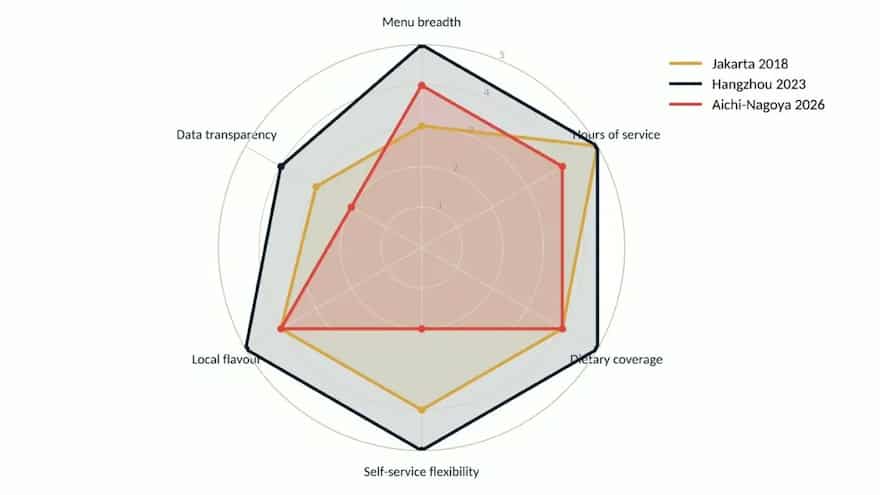
- 5 Nutrition: our model puts a precision athlete at about 2,160 kcal and a marathoner at about 3,920 kcal. One buffet has to serve both. 6 Scorecard: Hangzhou leads. Aichi-Nagoya trails on portion freedom and data transparency, with fixed portions drawing complaints.
The fix: for Doha 2030, publish a food ledger, guarantee portions, and count the favourites.
The Question Nobody Asked
As the Asian Games close tomorrow, we set out to do something that sounds simple. Analyse everything served to the contingents, from New Delhi in 1951 to Aichi-Nagoya now, dish by dish, and work out what was eaten, repeated, favoured and loved. It cannot be done. Not because the maths is hard, but because the numbers were never published. In seventy-five years of Games we found no public, dish-level record of what athletes actually consumed at any edition. For the first half-century there is not even a menu. After 2010 there are press releases, caterers' brochures and a few quotes from sous chefs.
The medal table runs to thousands of rows and is audited to the decimal. The food has anecdotes. That is the finding, and it is the same finding I made about the audience in the last piece: the Games counts what it can celebrate and ignores what it should measure. So we did three things. We assembled every verified number we could find. We modelled nutrition from published sports-science guidelines. And we scored editions and contingents with a transparent rubric. Everything modelled or scored is marked as such, and none of it is dressed up as measurement.
The Games counts every medal and no meal.
1 THE SCALE
Twenty-four Times More Mouths
The first Asian Games, in New Delhi in 1951, had 489 athletes. Hangzhou in 2023 had 11,909. That is a 24-fold increase in people to feed. By 1982, when Delhi hosted again and built the first Asian Games Village, there were 3,411 athletes from 33 nations. In 2010, Guangzhou fed about 9,700 athletes from 45 countries.
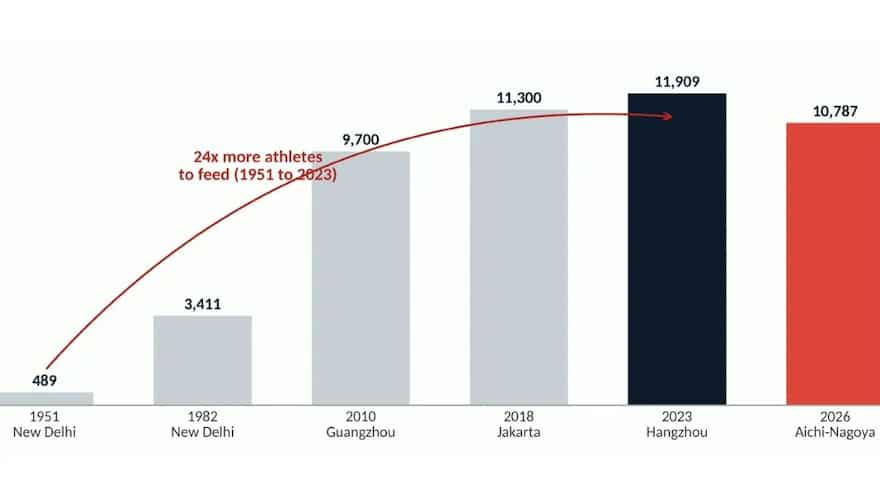
(Athletes at selected Asian Games. Sources: Wikipedia editions, PKL (Guangzhou 2010). The 2026 figure is the Games' infobox count; reports of the 2026 kitchen cite 11,000 or more.)
Athletes are only part of the plate. For Aichi-Nagoya, the Olympic Council of Asia put the people to accommodate more than 17,000 athletes and support staff, plus another 5,000 technical officials. That is over 22,000 people who need to eat. Consider the throughput. At Guangzhou, the master caterer produced 800,000 meals in 66 days, about 12,100 a day. At Jakarta in 2018, the dining hall had 3,500 seats and served around 7,000 people at peak. At Hangzhou, 4,200 seats served around 10,000. If each person eats three meals, every seat in Jakarta turned over about six times a day and every seat in Hangzhou about seven. A restaurant that turns every table seven times a day is not a restaurant. It is a railway station.
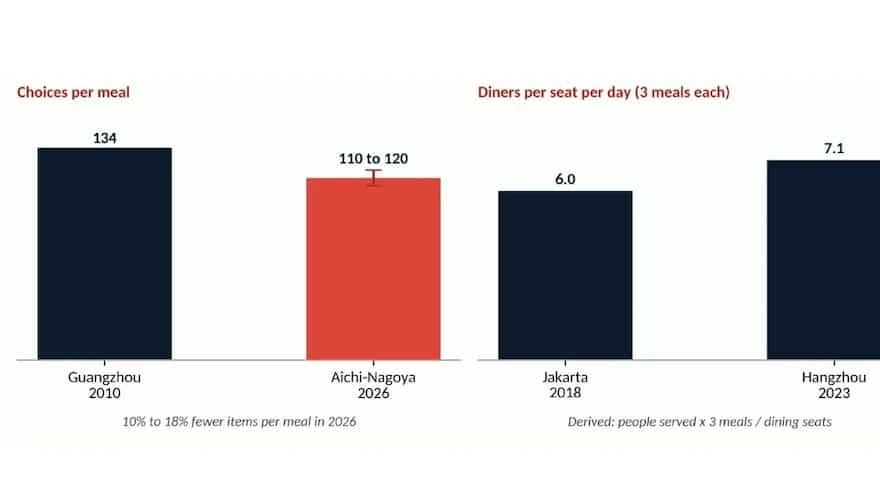
(Left: items offered per meal at Guangzhou 2010 (22 entrees, 12 vegetable dishes, 100 cold dishes) against the 110 to 120 reported for Aichi-Nagoya 2026. Right: derived seat turnover, assuming three meals per person per day.)
Feeding an Asian Games is not catering. It is logistics with a menu.
2 THE VARIETY
More Choice Than Ever, And Nobody Agrees How Much
Every host boasts about the menu. Guangzhou 2010 served 22 entrees, 12 vegetable dishes and 100 cold dishes at every meal, 134 items in all. Incheon 2014 reported 548 food items served around the clock. Jakarta 2018 fed athletes from 5 a.m. to 1 a.m. with Indonesian, Western, Middle Eastern, Central Asian and Southeast Asian food. Hangzhou 2023 served about 400 dishes a day across seven cuisines, 20 hours a day for 16 days. Then comes Aichi-Nagoya, and the numbers fall apart. One report, citing the organising committee, says 35 dishes are offered in the athletes' dining hall. Another, from the August press preview, says around 370 items. A third, from inside the kitchen, says about 450 dishes rotated through the day, with 110 to 120 items on offer at each meal. The highest figure is almost 13 times the lowest. There are charitable readings. The units may differ: a dish, a menu item, a daily offering. But when three reports about one dining hall cannot agree on the order of magnitude, the Games have a measurement problem, not a catering problem.
Here is the only like-for-like comparison we can make. At Guangzhou, 134 items per meal. At Aichi-Nagoya, 110 to 120 per meal. Per-meal choice in 2026 is 10% to 18% lower than it was sixteen years ago. More people, wider menus on paper, and less to choose from at the counter. And choice is not adequacy. Aichi-Nagoya's kitchen is run by 80 chefs from 25 countries and about 200 staff, and its daily supply list is impressive: 60,000 bananas, a ton of rice, two tons of chicken, up to 35,000 loaves of bread, 30 kg of almonds. But the athletes who filmed their plates told a different story, which we come to below. Variety is a promise. Portion is the proof.
3 THE REPEATS
What Comes Back, Games After Games
If you cannot count what was eaten, you can at least count what was reported. We mapped eight food categories against five editions, marking only what the hosts or caterers said they offered.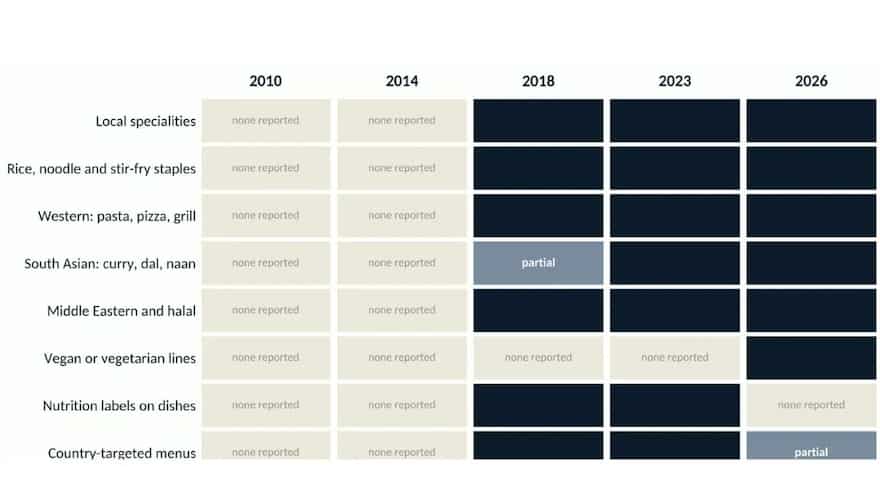
(What each Games reported offering. Navy means reported, grey means nothing reported. For 2010 and 2014, only item counts were published, so every category reads empty. Source: host and caterer statements compiled from press reports.)
The map says two things. First, for 2010 and 2014 there is nothing: counts, but no cuisines, no halal policy, no labelling. Second, for the three editions with detail, a core repeats every time. Local specialities, rice and noodle staples, Western pasta and grill, a South Asian curry and bread offer, and a Middle Eastern and halal offer appear in all three. Nutrition labelling appears in two, Jakarta and Hangzhou. Vegan lines appear only in Aichi-Nagoya.
What about the favourites? Reports give us a handful of data points, and they are anecdotes from officials, not consumption data. At Jakarta, fried rice was among the most sought-after dishes, and pasta in bolognese sauce was a reported favourite. At Hangzhou, the Food Safety Operations
Centre said Dongpo pork and Sister Song's fish soup were the athletes' favourites, while the Wenzhou village reported more than 60 local delicacies, including fish cakes, proving popular, and the Tonglu village served Arabic lamb, hand-grabbed rice and naan to order. At Aichi-Nagoya, the kitchen features Nagoya specialities such as tebasaki chicken wings and kishimen noodles, and also rogan josh, dal, curry, chutney, naan and biryani. No popularity data has been published. Read the pattern, not the dishes. Athletes vote with their forks for two things: a carbohydrate they trust, and one local dish they can tell their friends about. Everything else is wallpaper.
A favourite is a data point only if someone counts it.
4 THE CONTINGENTS
Five Tables, One Buffet
Asia is not one food culture. The Games feeds at least five, and one dining hall has to serve all of them at once. We grouped contingents into five regional clusters and scored the typical dietary needs of each on six dimensions. This is an analyst scoring, based on general dietary patterns and the menu structures hosts report, not a survey of athletes.
(Typical dietary profile by regional cluster, scored 0 to 5 by us. Indicative, not measured. East Asia is Japan, China and Korea; South Asia includes India, Pakistan, Bangladesh, Sri Lanka and Nepal.)
The shapes differ sharply. West Asia and the Gulf peak on halal need and red meat. Central Asia pairs halal with lamb. Southeast Asia leans on rice, spice and halal together. East Asia is rice and noodles, with a high reliance on home food: at the Rio Olympics, South Korean athletes had kimchi shipped from home. South Asia is the widest shape, with the highest spice and the highest vegetarian need.
The Aichi-Nagoya kitchen has read this map. Its caterer, Global Hospitality Group, says 90% of the food will be halal and kept separate from other dishes, and the organisers published a Muslim-friendly dining policy. When nine-tenths of a menu is halal, the majority need has been named. It is a sound design decision, and it comes with a corollary: the vegetarian and vegan athlete is now the minority that needs the most careful planning. That includes much of the Indian contingent.
The joint position statement of the Academy of Nutrition and Dietetics, Dietitians of Canada and the American College of Sports Medicine warns that vegetarian athletes can be at risk of low intakes of energy, protein, fat, creatine, carnosine, omega-3 fatty acids, and key micronutrients such as iron, calcium, riboflavin, zinc and vitamin B12. The 2026 menu does offer dal, naan and biryani. A menu line is not a protein plan. Contingents also have little room to fix it themselves.
At Jakarta 2018, the organisers banned athletes from consuming outside food in their accommodation. At Aichi-Nagoya, athletes did not serve themselves; volunteers ladled fixed portions. The Thai teqball team shared a video of rice in a paper cup, a small cup of soup, three pieces of chicken, some pasta and a piece of broccoli. A Korean report said some athletes, unable to bear the hunger, left the village and bought their own meals.
Hunger does not read the menu.
5 THE NUTRITION
What A Plate Has To Do
The same buffet has to feed a rifle shooter and a marathoner. We modelled what that means using the joint position statement's ranges: carbohydrate of 3 to 10 grams per kilogram of body weight a day, protein of 1.2 to 2.0 grams per kilogram, and fat at 20% to 35% of energy. For a 70 kg reference athlete, we picked four archetypes and set a target point inside each range. A precision athlete, such as a shooter or an archer, comes out at about 2,160 kcal a day.
A power athlete, in shot put or weightlifting, comes out at about 2,720. A team and field athlete, in hockey or kabaddi, at about 2,956. An endurance athlete, in the marathon or 10,000 metres, at about 3,920. The endurance athlete needs 1.8 times the energy of the shooter, and 2.25 times the carbohydrate per kilogram.
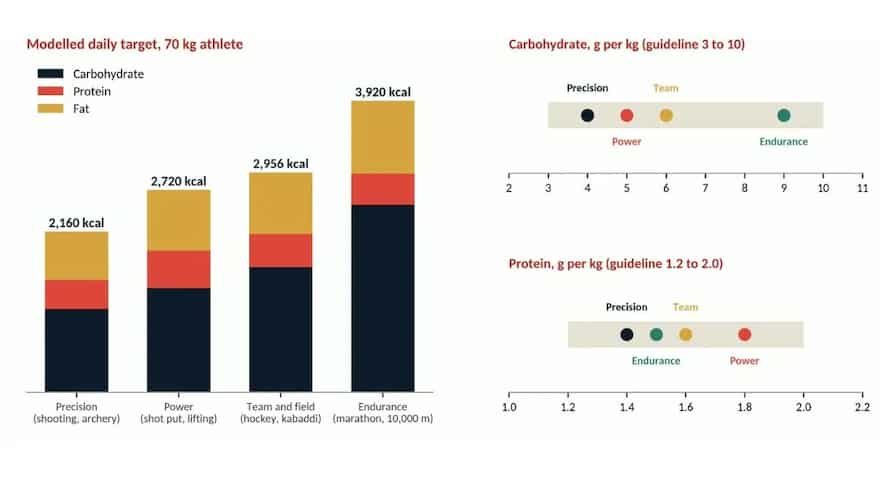
(Modelled daily targets for a 70 kg reference athlete. These are illustrative points inside the ACSM, Academy of Nutrition and Dietetics and Dietitians of Canada guideline ranges, not prescriptions and not observed intakes.)
India's results at these Games came from all four worlds. A marathon silver and a 10,000 metres silver sit in the endurance column. A shot-put silver and a weightlifting silver sit in power. The kabaddi golds and the cricket and hockey teams sit in team and field. The mixed air pistol gold sits in precision. Four nutritional worlds, one dining hall. Map the food to the macros and the stakes are clear. Rice, pasta and bread carry the carbohydrate load. Chicken, fish, eggs and dal carry the protein.
Fruit, vegetables and salad bars carry the micronutrients. A buffet that works for the marathoner has to pile the carbohydrate high. A buffet that works for the shooter has to let her take less without apology. That is why a fixed ladle is the wrong tool: it treats a 2,160 kcal athlete and a 3,920 kcal athlete as the same person.
A ladle is a policy. It says every athlete is the same size.
6 THE COMPARISON
Three Editions, One Scorecard
To compare the three most recent editions with detail, we scored each on six dimensions from 1 to 5, using only what was reported. Menu breadth reflects item counts and cuisines. Hours of service reflects the published operating window. Dietary coverage reflects halal, vegan and allergen provision and labelling. Self-service flexibility reflects whether athletes control their own portions. Local flavour reflects the presence of host-city dishes. Data transparency reflects how clearly the host published what it served.
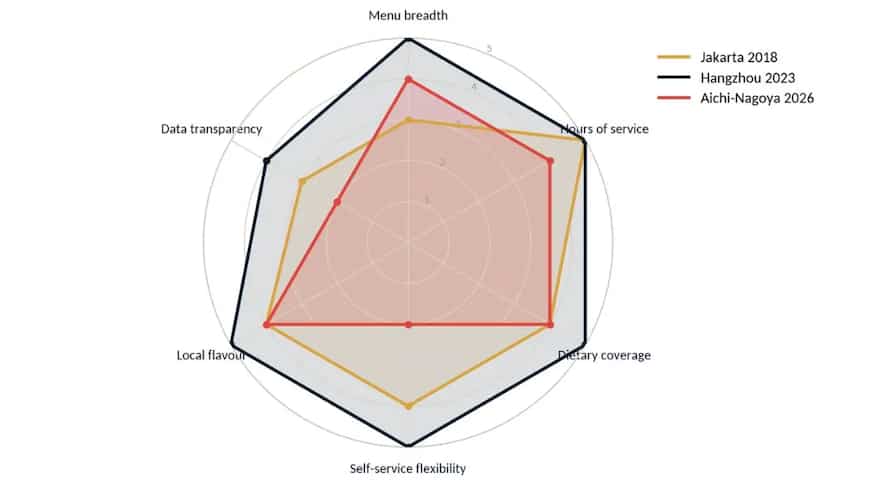
(Analyst scoring, 1 to 5, based on reported provision at Jakarta 2018, Hangzhou 2023 and Aichi-Nagoya 2026. Indicative, not measured.)
Hangzhou leads on five of six, for a reason that is easy to explain. It published menu cards with nutritional content, main ingredients, allergens and cooking methods for every dish, ran a selfservice model and told the world how many dishes it would serve. Jakarta earns strong marks for country-targeted menus and round-the-clock service. Aichi-Nagoya scores well on halal and vegan provision and on local flavour, and badly on portion freedom and on data transparency, where its own menu counts do not agree.
Average the six scores and the ranking is plain: Hangzhou 4.8, Jakarta 3.8, Aichi-Nagoya 3.3. The widest gaps are on self-service flexibility, where Hangzhou scores five and Aichi-Nagoya two, and on data transparency, where the same pair scores four and two. Those two dimensions cost the least to fix. They are also the two that nobody puts in a press release. There is a likely cause, though we cannot prove it. Aichi-Nagoya has been a Games of austerity. Its budget was estimated at about 85 billion yen, roughly $560 million, and relying on a cruise ship and temporary housing for the athletes' village was credited with saving 100 billion yen. When you cut the village, the kitchen is where the cut lands first.
The next two hosts are changing the model. The Olympic Council of Asia says Doha in 2030 and Riyadh in 2034 will have dedicated athletes' villages. Both are Gulf hosts, with halal-native food cultures. That makes the next decade of Asian Games food a different problem: not how to add halal to a menu, but how to add everything else to a halal one.
When you cut the village, you cut the kitchen.
7 THE PRIORITIES
A Two-By-Two For The Next Games
If you were a chef de mission, or an organiser, where would you start? We scored nine initiatives on ease of doing and impact on the athlete. These are our judgements, offered as a starting point for debate.
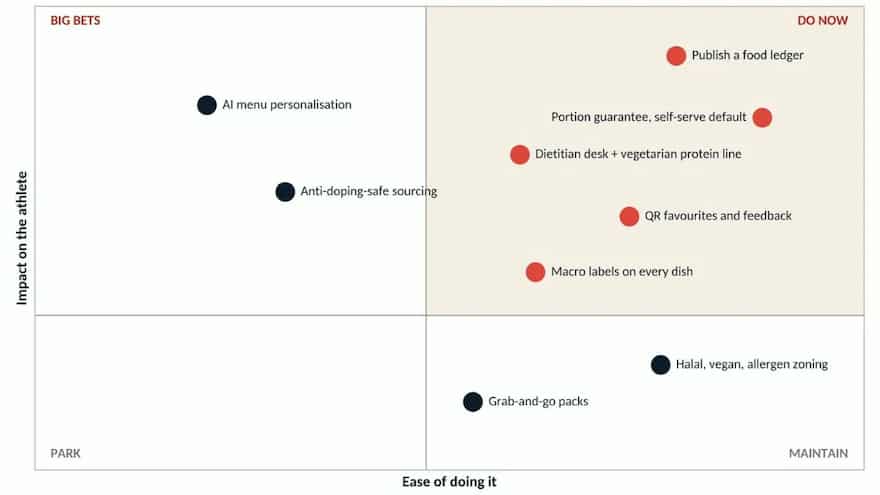
Impact versus ease for nine food initiatives. Analyst judgement, not measurement.
Five land in the top right. Publishing a food ledger costs almost nothing and changes everything that follows. A portion guarantee, with self-service as the default, removes the single biggest complaint of this Games. A dietitian desk and a vegetarian protein line serve the contingents most at risk. QR-based favourites and feedback turn anecdotes into data. And macro labels on every dish finish the job Hangzhou started.
The big bets are harder. Personalised menus by contingent, perhaps with AI helping dietitians map each delegation's needs, would be a leap in service, but it needs data that does not yet exist. Antidoping-safe sourcing and testing is expensive but essential, and Hangzhou showed it can be done, with rigorous testing of every food item brought into the village. Halal, vegan and allergen zoning is already largely done and belongs in the maintain box. Grab-and-go packs are useful at venues and rank lower in impact.
The cheapest upgrade in the Asian Games is a spreadsheet.
8 THE SWOT
The Asian Games Food System
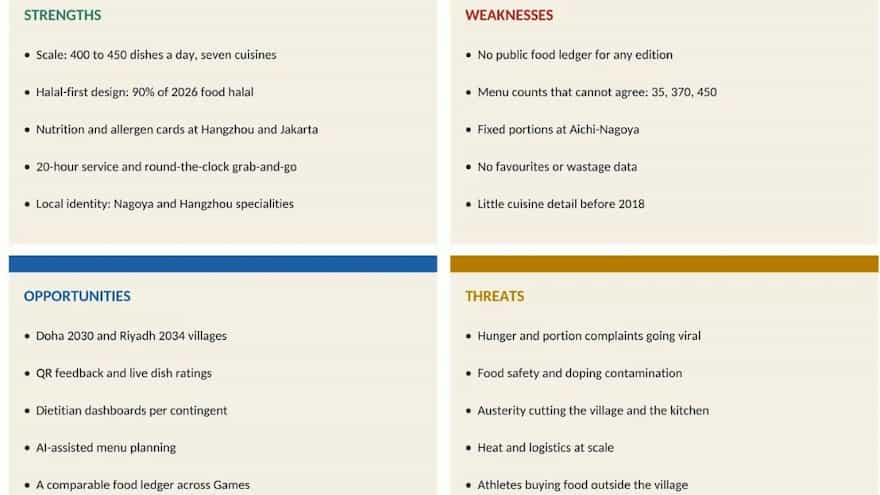
METHOD IN BRIEF
- Verified facts: athlete counts, meals, seats, hours, item counts and favourites come from host and caterer statements and press reports, cited in the text.
- Derived figures: 24x growth, 12,100 meals a day, seat turnover and the 10% to 18% choice gap are our arithmetic on those facts.
- Modelled figures: the nutrition archetypes are illustrative targets inside published guideline ranges for a 70 kg athlete, not observed intakes.
- Scored figures: the contingent profiles, the edition scorecard and the priority matrix are analyst judgements, shown to be debated.
What Our Analysis Says, On The Day Of Closing
Put the pieces together. The Asian Games has built a kitchen of astonishing scale: more than 10,000 athletes, 20 hours a day, hundreds of dishes, halal-first at Aichi-Nagoya, labelled at Hangzhou. It has gone further than most people notice in making room for five regional food cultures at one table.
And yet, for seventy-five years, the Games has not published the one thing a serious system would. How much food, which dishes, in what portions, loved by whom, wasted by how much. We can describe the kitchen. We cannot audit it. The next Games can change that for almost nothing. A food ledger is a spreadsheet.
A portion guarantee is a policy. A favourites count is a QR code. The athletes will not ask for it. They are busy. Someone has to ask on their behalf.
FIVE ASKS FOR DOHA 2030
1. Publish a food ledger. Daily menu, items served, portions, top 20 dishes and wastage, released within a week of the closing ceremony.
2. Guarantee portions. Self-service by default, with extra helpings never refused to an athlete mid-competition.
3. Label everything. Calories, macros and allergens on every dish, in the language of every contingent.
4. Serve the vegetarian athlete properly. A dietitian desk and a protein line built for the contingents most at risk.
5. Count the favourites. QR ratings at every station, with results published, so that the dishes athletes love can be repeated on purpose.
The Asian Games ends today. By the end of the week, there will be a medal table. What there will not be is a plate table. Somebody should write one.
Count the medals. Then count the meals.




