


 Share
Share

When the tumult of Ganesh Chaturthi subsides—when the final idol has dissolved in the waters, and the processionary drums lie silent—the visible form of Ganapati vanishes. Yet the god remains, abiding not in stone or clay, but in the kitchens of His votaries, in the sweetmeats fashioned in His honour, in the very act of nourishment raised to the dignity of worship.
Ganapati, remover of obstacles, is also the divine gourmand: the patron of kitchens and the arbiter of sweets. To follow Him across the world is to trace not merely a line of faith, but a map of taste, in which dumplings, laddus, and saccharine offerings form a culinary scripture.
India: The Sacred Hearth of Modak and Laddu
In Maharashtra, His most treasured delicacy is the ukadiche modak: a dumpling of rice flour, steamed to a snowy sheen, concealing within its fragile shell the molten richness of jaggery and coconut. It is not food alone, but sacrament, eaten in the faith that to taste sweetness is to taste divinity.
In the Tamizh country, the same offering assumes the form of kozhukattai, perfumed with cardamom and steamed in leaves, while in Andhra and Karnataka the golden laddu is placed in His hand—globes of sweetness, motichoor or besan, which seem like miniature planets orbiting their cosmic Lord. The Konkan shores add patholi, rice rolls steamed within turmeric leaves, whose fragrance merges rustic simplicity with ritual splendour.

Nepal: The Yomari, a Himalayan Homage
Beyond the Himalayas, in Nepal, Ganapati is offered the yomari, a rice-flour dumpling filled with sesame and jaggery. It is at once cousin to the Indian modak and a distinct local hymn in flour and sweetness, proving that culinary devotion adapts its form without abandoning its essence.
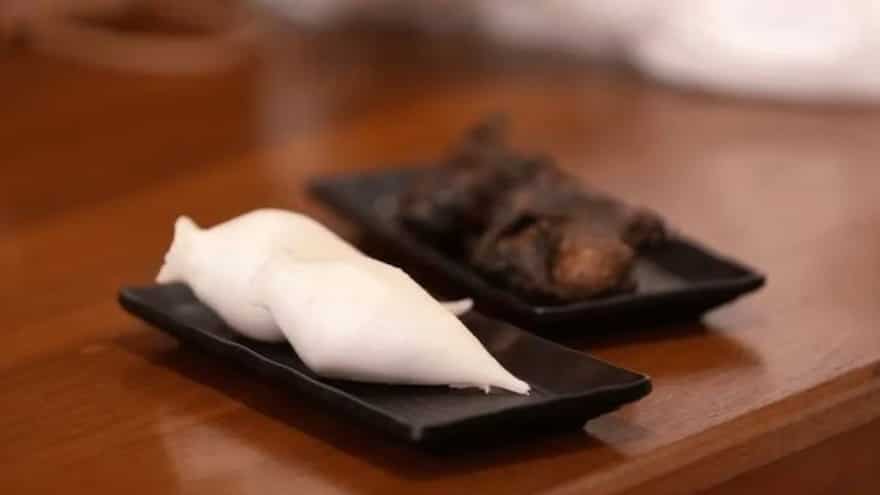
Japan: Kangiten and the Bean-Paste Bun
In Japan, Ganapati lives as Kangiten, the esoteric deity of joy, portrayed with twin bodies conjoined. Here the votaries prepare manju buns, cloud-like in texture, filled with bean paste. To enter a Kyoto temple and taste such offerings is to perceive how divinity, in passing through cultures, alters its garment but not its soul.

Southeast Asia: Dumplings Along the Mekong
In Thailand, Cambodia, and Vietnam, Ganapati’s taste takes the form of sweet dumplings named num kom, knom tom, or bánh ít. Wrapped in local leaves, moistened with coconut, and shaped with meticulous devotion, they echo the modak’s form, demonstrating how a single archetype of sacred food radiates outward across Asia like the branches of a spreading banyan.

Diaspora Isles: The Indentured Memory of Sweetness
In Mauritius, in Fiji, in Trinidad, the festival of Ganapati endures through the culinary memory of those once transported across oceans. The kitchens of the diaspora still steam kozhukattai and roll laddus as their ancestors did, the continuity of ritual proving more enduring than the tempests of history. In those islands, thousands of miles from the temples of India, the taste of jaggery and coconut still binds the worshipper to the Lord.

The Occident: Adaptation and Invention
In the United States, the United Kingdom, Canada, and Australia, Ganapati’s sweets take new forms. Here the chocolate modak emerges, filled with praline or almond paste, standing beside the traditional jaggery-laden offering. In temples of Edison, Wembley, and Sydney, queues form not only for the classics but for these novelties—modern inventions which, far from betraying tradition, reveal its resilience. Ganapati smiles equally upon the old and the new, for it is devotion that sanctifies, not the ingredient.

The Dumpling as Archetype
What unites this panorama is the recurrence of a single form: the dumpling. Whether called modak, kozhukattai, yomari, manju, num kom, bánh ít, or reinvented as chocolate confections in the West, it is always the same in essence: a pouch of dough concealing sweetness, a morsel in which culinary art converges with sacramental meaning. The dumpling becomes a universal hymn, a common tongue of worship across cultures and continents.
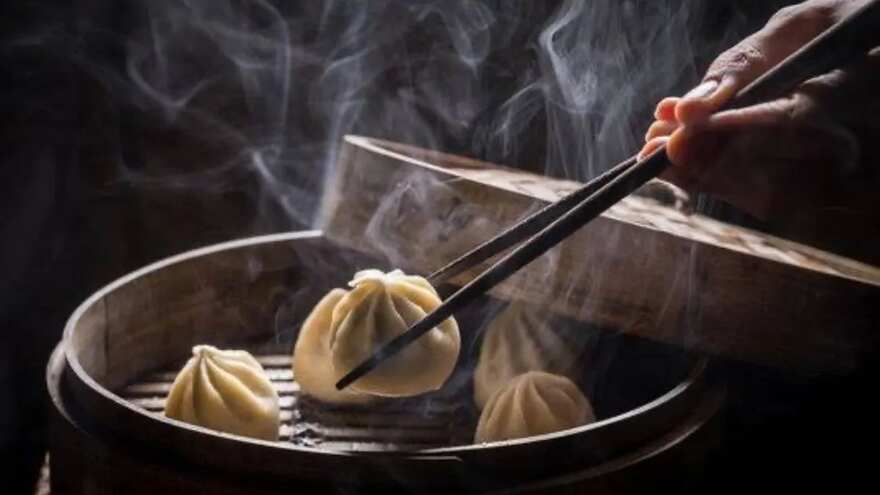
The Hymn Beyond Borders
As Muthuswami Dikshitar’s “Vatapi Ganapatim” resounds across centuries, linking the Pallava conquest of Vatapi with the sanctity of Tamil shrines, so too does the dumpling carry Ganapati’s devotion across oceans. Music and food alike transcend geography; both are acts of remembrance that transform the temporal into the eternal.The Eternal Banquet of the God
When the visarjan concludes and the idols dissolve, Ganapati remains—in the modak steaming in Pune, in the yomari of Kathmandu, in the manju of Kyoto, in the bánh ít of Vietnam, in the chocolate modak of New Jersey. The clay may return to earth, but the god is eternal in sweetness.
Thus, Ganapati reigns not merely as the remover of obstacles, but as the benign patron of kitchens, the divine gourmand whose empire is the palate, whose dominion is delight, and whose banquet stretches across the world like a liturgy of taste.




