


 Share
Share

There's something quietly revolutionary about stepping into your garden to pick tonight's dinner. It’s a phenomenon we see on the rise the world over, from rooftop gardens to quaint homesteads. But for Asha Girish Shenoy, this daily ritual has become more than just a source of fresh vegetables, it's a complete reimagining of what it means to live and eat well in one of the world's most challenging climates.
In the heart of Dubai, where temperatures can soar to punishing heights with record highs of 49°C, and the desert seems determined to reclaim every patch of green, Asha has spent the past four years transforming her backyard into a thriving kitchen garden. But this isn't simply a story about growing your own food. It's about reconnecting with nature, redefining success, and discovering that the most nourishing things in life often come from the soil beneath our feet.
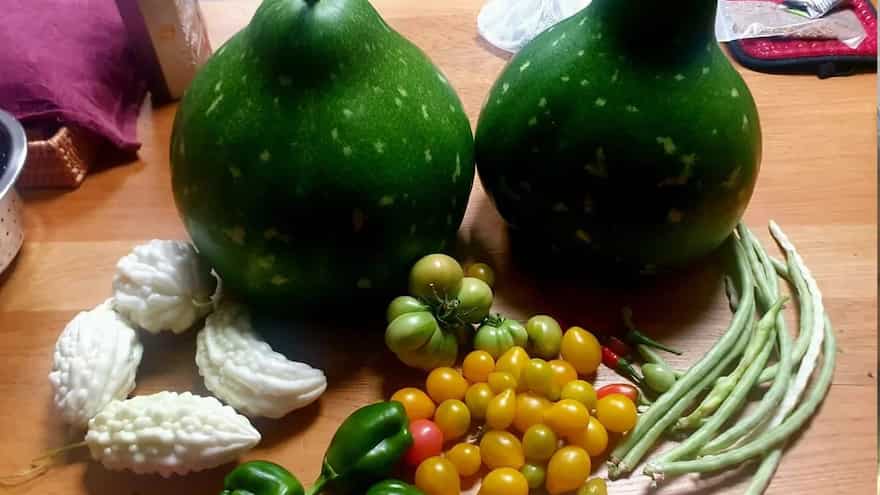 Abundance and diversity in the desert.
The Unexpected Organic Journey
Asha's path to becoming an urban gardener wasn't one that had been meticulously planned or prepped for her whole life. She hadn't left her corporate career with visions of rows of tomatoes and climbing beans, but life, as it so often does, had other ideas. "I had not left the job for kitchen gardening. I had decided to take a break and then soon after my husband, Girish, had a two-year posting in Constanta, Romania in 2008," she recalls. It was in Romania, of all places, that the seed was planted (quite literally). The couple found themselves housed in a bungalow with a yard, and Asha quickly noticed something peculiar about the local relationship with vegetables.
"In those days, the natives had a peculiar relationship with vegetables, it was consumed either during Lent or if you were ill!" she explains. “Since we were housed in a bungalow with a yard, out of necessity, I decided to try my hand at kitchen gardening to grow what we couldn’t buy. Being my first tryst with gardening, it was on a very small scale. However, it was such a wonderful experience that I decided I would pursue this whenever circumstances permit, which happened only in October 2021.”
That first small-scale experiment proved to be a revelation. Though she wouldn't return to serious gardening for another thirteen years, the experience had quietly lodged itself in her heart, waiting for the right moment to bloom.
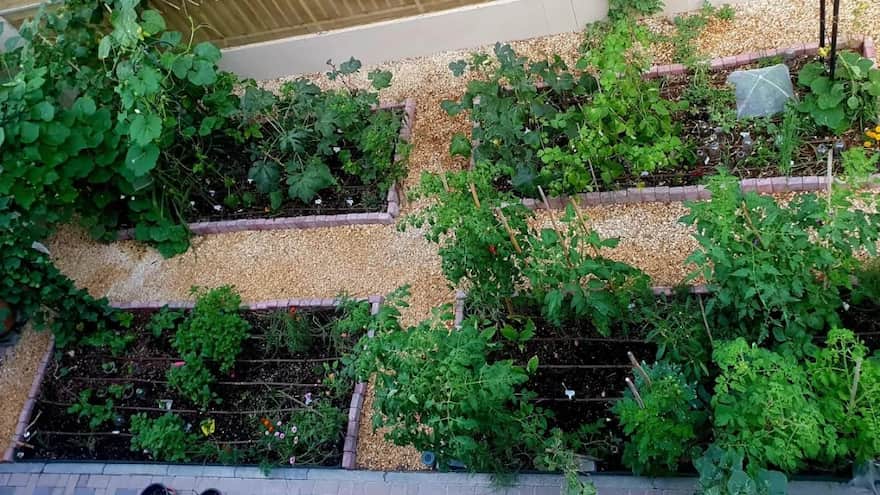 The garden - unassuming from above, but rife with opportunity
Wrestling With The Desert
When Asha finally committed to kitchen gardening in Dubai in 2021, she quickly learnt that nature doesn't play by anyone’s rules. Dubai's extreme climate presents challenges that would daunt even the most green-thumbed gardener. It's a place where the sun can be both life-giver and destroyer, where a few degrees' difference means the difference between thriving plants and withered dreams. "Gardening tells you very promptly that climate change has happened. For me, each of the four years have been different with its own challenges," she notes.
The biggest obstacle? Time itself. Or rather, the lack of it. The growing window in Dubai is brutally short. Five to six months from September or October through to February or March, squeezed between the scorching summer heat and the return of unbearable temperatures. But where there’s a will there’s a way, and Asha found methods to navigate around these challenges. “I have tried to jump start the process by starting indoors under grow lights and providing shade cloth for the saplings until about mid-October instead of waiting for the temperature to reach acceptable levels.” Finding success in these conditions proves to be a negotiation with nature, one that requires patience, creativity, and an acceptance that sometimes, despite your best efforts, things simply won't work.
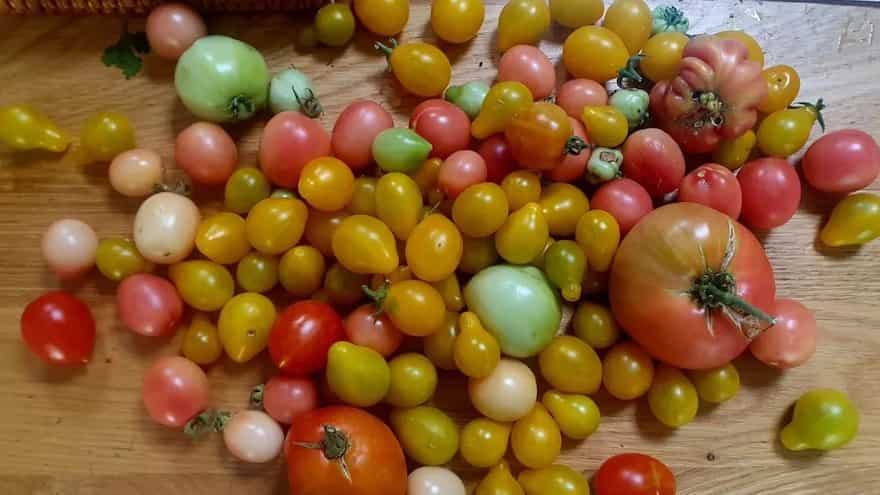 Diversity of produce, even by category is the key
A Garden Of Abundance
Though its 324 square foot space may seem modest, its 250 kg yield in 2023 and 350 kg in 2024 say otherwise. Walk through Asha's garden today and you'll find an impressive diversity: cucumbers and butternut pumpkin, green and red okra, onion chives and garlic chives, methi (fenugreek) and coriander, noodle beans and amaranth leaves, sponge gourd and snake gourd and ash gourd, hyacinth beans and tindli, basil and tomatoes, even turmeric that she dries and powders herself. There are pickled chillies and, when fortune smiles, the occasional sweet melon.
The list reads like a love letter to biodiversity, and Asha attempts to grow about thirty different types of vegetables each season, often experimenting with multiple varieties of the same vegetable to see what thrives and what tastes best.
But beyond the satisfaction, there have been tangible benefits. “There are few things more satisfying than stepping into the garden to pick the harvest for the day’s meal - farm to table doesn’t get fresher than this,” she explaining, “In addition to the emotional high, I have seen a significant improvement in both of my children’s immunity in the last couple of years. Also, garden work does save me a gym membership!”
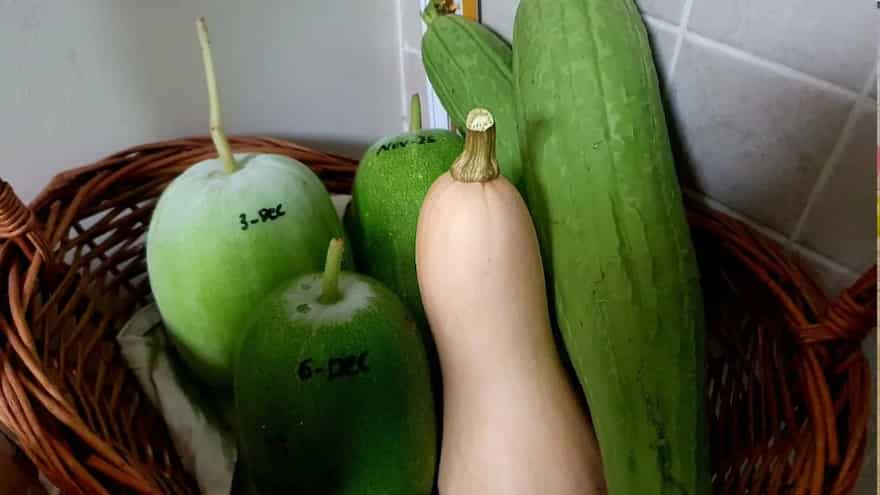 Asha discovered gourds can survive outside for months at a time (and labels them to keep track)
On The Plate - Turning Produce To Products
When you’re growing in such abundance and with short periods of time when the odds are favourable, finding ways to make the most of things becomes another challenge. In addition to gardening, Asha has also become a preservation expert, ensuring that her garden's bounty stretches as far as possible. Her approach to tomatoes alone demonstrates remarkable resourcefulness. Surplus tomatoes are sun-dried or oven-dried and preserved in olive oil, transformed into pasta sauce and frozen, bottled as tomato pickles, or the inner pulp is frozen for sambars and rasam. The rest are frozen whole for future curries.
Bittergourd gets sun-dried with salt and chilli powder or frozen for later. And some vegetables, like butternut pumpkin and ash gourd, possess an almost magical quality, they can sit on her kitchen counter for nearly nine months without degrading, natural time capsules of summer's abundance.
 Going chemical free was a challenge, but gives Asha peace of mind that her produce is pure
The Art Of Sustainable Living - Closing The Loop
Perhaps what's most impressive about Asha's approach is how it extends far beyond simply growing food. She's created a closed-loop system where waste barely exists. All kitchen and garden waste goes into tumbler composting, in-soil composting, Bokashi composting, or vermicomposting. She even collects vegetable kitchen waste from her neighbour, putting her spare capacity to good use.
Coconut shell husks, after grating, are burnt in a charcoal starter. Egg shells are crushed and fed to the compost. Orange peels become bio-enzyme, used to clean the entire house and fertilise the garden, before the peels themselves are composted. Dried bottle gourd shells transform into pots and containers. Dried luffas from sponge gourd serve as body scrubs and scouring pads. "Venturing into kitchen gardening has significantly improved our relationship with nature." It's a beautiful example of circular living, where everything has purpose and nothing is truly discarded. Each element feeds into the next, creating a system that's both practical and aspirational. This is sustainable living at its most effective.
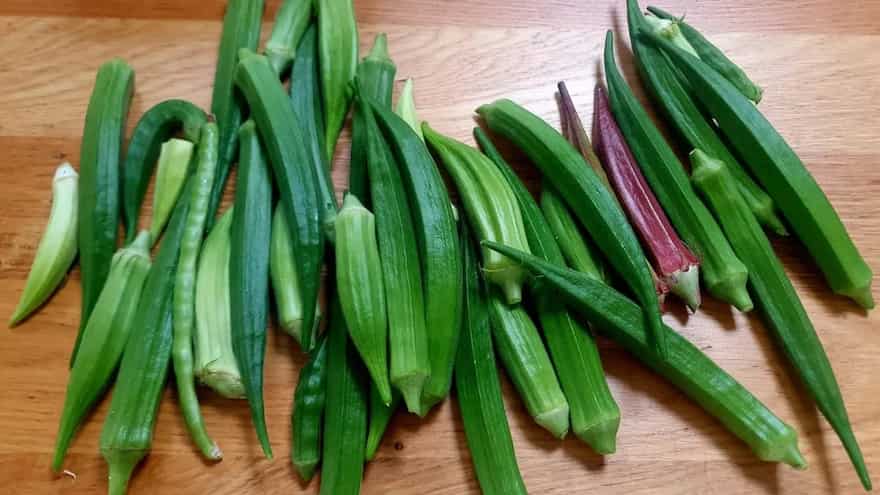 Simple staples take on new life in Asha's garden
Asha's Lessons From The Soil
Starting from scratch means that Asha learned many lessons the hands-on way, and one of the most important, she believes, is about the longevity of fresh produce. "My biggest surprise was that food grown in the most natural way, without any external intervention, stays fresh for a very long time. Of course, this requires more effort but the reward far outweighs the effort."
She's watched tomatoes stay fresh on the kitchen counter for forty-five to sixty days, witnessed vegetables maintain their vitality for months. These are things she wouldn't have believed without experiencing them herself. It's made her reconsider everything she thought she knew about food and freshness.
But perhaps the most profound lesson has been simpler and more universal. "What goes in, comes out is not just applicable to humans, but for plants as well. Nutritious food translates to improved health and immunity," she says.
And then there's the character-building aspect of it all. Gardening without pesticides has been, in her words, 'an exercise in humility and adaption'. Some seasons are generous, others less so. Some plants thrive whilst others mysteriously fail. The garden keeps you honest, keeps you learning, keeps you humble.
 A small, but beautiful oasis.
Starting Small - Expert Tips For A Home Vegetable Garden
Home gardening need not be an undertaking at a grand scale, but a personal project that adds fun and flavour to an everyday diet. For those feeling inspired but intimidated, Asha's advice is refreshingly practical. You don't need a sprawling yard or perfect conditions. Many vegetables can thrive on a balcony with just two to three hours of sunlight.
She particularly recommends Bokashi composting for apartment dwellers, it's odour-free, doesn't require brown waste, and produces a pickled pre-compost that can be buried in a pot of soil, breaking down into usable soil within three to four weeks.
As for what to grow? Start with the easiest, no-fuss options. She recommends mint, methi, coriander, onion and garlic, small varieties of amaranth, carrots, and even beetroot. These can all be grown in grow bags and handle shade well. If you have more space and sunlight, tomatoes, okra, and cucumbers are good candidates. "If you find gardening intimidating, start small and simple. When the reward comes, you will most likely be tempted to get more adventurous with the choices!"
 Asha continues to grow and thrive, as does her garden.
The Road To Learning Keeps On Growing
Many experiences in life come with unexpected learning opportunities, and gardening is no different. After four years, Asha still holds the belief that she’s a student of the earth. The produce has been abundant, yes, but she feels it hasn't yet reached its full potential. "A gardener never stops learning. Even after four years I am correcting my old mistakes and then making new ones!" she says.
She's particularly interested in learning more about companion planting tailored to Dubai's unique microclimate. It's a reminder that gardening wisdom, no matter how universal some principles might be, must always be adapted to local conditions. "It's not always easy to copy paste someone else's success in your own backyard especially in Dubai's environment."
For now, she remains focused on her own plot of land, continuing to experiment with various varieties to discover what offers the best flavour and adapts well to the local environment. There's no grand plan to build a wider community or movement—just the quiet, persistent work of learning to grow food in a place that seems determined to make it difficult.
That may be the real story at play here. Not radical, flashy transitions or revolutionary change, but the daily practice of showing up, paying attention, and nurturing growth, in plants, in soil, in understanding, in life. It's about discovering that you don't need to leave your corporate path to find purpose, you just need to be willing to get your hands dirty and see what grows.
* All images courtesy Asha Girish Shenoy.




