


 Share


In the days leading up to Chhath Puja, a four-day festival devoted to the Sun God and Chhathi Maiya, the entire rhythm of my home would shift before even the festivities started. The house did not just host the festival; rather, it lived it, and even the smallest duties felt sacred. Sitting on a woven mat in the courtyard with all my cousins, carefully washing heaps of seasonal fruits, gently scrubbing water chestnuts, and wiping down sugarcane stalks until they gleamed, felt like a tournament.
From the kitchen came a constant, familiar hiss of fresh pooris puffing up in hot ghee, mingling with the sweet, nutty aroma of roasting wheat to be used for prepping thekua. In the middle of all this, sat my grandmother, guiding everyone with a to-do list, as she arranged bananas, coconuts, and ginger-turmeric roots into the bamboo basket, also called a ‘daura’. Relatives would come one after the other, trading stories over cups of tea, while suitcases lay half-unpacked in the corners, with clothes waiting to be worn for the day ahead. It was a joyful, organised chaos where everyone had a role to perform, even if it was as small as just handing over a clean brass plate.
Now, after marriage, the two days pass very differently. As Chhath is not observed in my in-laws’ home, the calendar dates for the festival arrive without the familiar buzz of preparation, leaving me to return to those scenes only in memory, which is often triggered in the middle of an ordinary autumn afternoon by the sudden aroma of ghee or the sight of soops piled outside a local market.
What aches the most is not the lack or absence of any particular dish or tradition, but losing that shared acceleration and gush of excitement. I miss the crowded rooms, the effortless overlapping of voices, and the quiet assurance of belonging to a space where every pair of hands was working with the heart full of the same devotion.
What Makes Chhath Puja Feel Like Home?
In my family, Chhath Puja did not stretch for four days, as we do not observe Nahay Khay or Kharna. Our devotion was anchored totally in the two arghyas, which are the evening offering to the setting sun and the early-morning offering to the rising sun. Those two days held all the importance and warmth of the festival for us as a family.
 (Credits: Freepik)
By the afternoon of Sandhya Arghya, the house already felt like a quiet, well-rehearsed clock. While the rest of us fussed over new clothes, my mother and aunts took over the kitchen with full military precision. With a house full of relatives returning hungry from the ghats, they had to fry nearly a hundred pooris heading out, and they had their own system to beat the clock.
One rolled out the dough at a constant, unbroken beat, another slid the rolled pooris into a wide kadhai of shining aromatic ghee, and a third stood ready with a slotted spoon, stacking the golden, puffed pooris into a wide steel casserole lined with cloth so they remained soft until they were consumed. The kitchen grew warm and fragrant, filled with the clatter of tongs and low, easy chatter as they worked alongside each other.
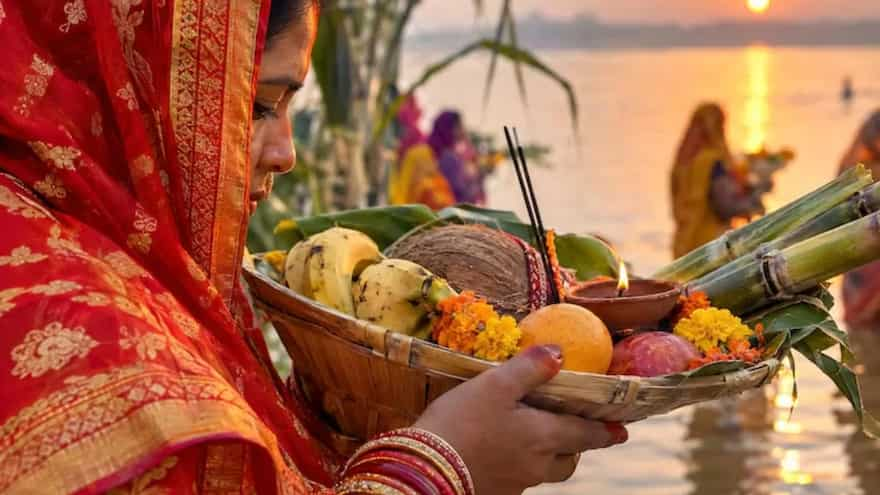
By late afternoon, we would step out together, the men and elders balancing the heavy bamboo dauras filled with dozens of bananas, sugarcane, and thekua on their heads, walking toward the Ganga ghat. Down by the river Ganga, the atmosphere was very different. It buzzed with folk songs, the sharp aroma of burning camphor, and the glow of earthen diyas flickering along each step. Families engraved out small spots on the riverbank, laying out their soops, lighting incense sticks, and wading ankle-deep in the cold water as the sky turned golden with setting rays of the sun and the first arghya of milk and water was poured toward it.
The next morning belonged to a totally different kind of stillness. Long before the rest of the city woke up, at three or four in the morning, my grandmother would already be at the River Ganga, stepping into the dark, cold water to wait for the dawn. Watching her stand waist-deep in the river, all wrapped in devotion, surrounded by hundreds of other silent devotees, soft chants, and the thin mist rising off the water, until the first orange rays begin to peep across the horizon, remains the single most vivid frame I carry from childhood.
Food That Stays With You
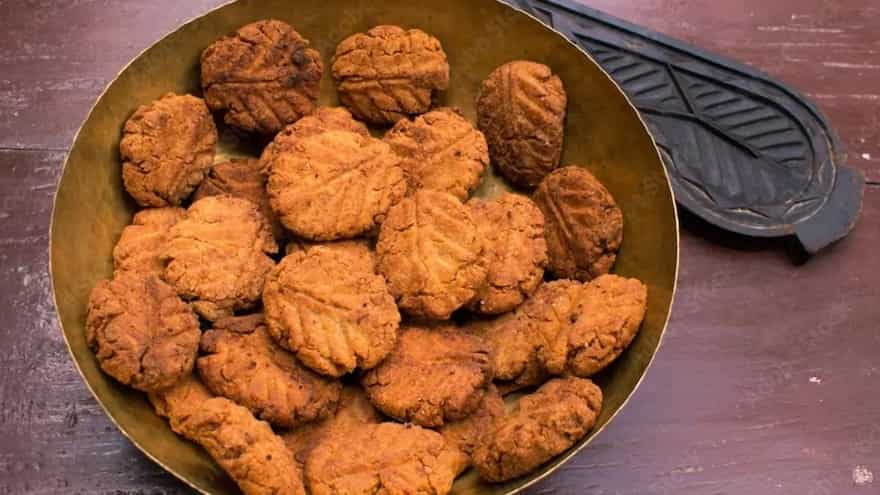
Every daura carried to the Ganga Ghat has its roots in the quiet, unhurried hours of the kitchen, and it always starts with prepping thekua, one of the most loved delights for Chhath Puja. As prasad has to be prepared with extreme purity, my grandmother would make a separate earthen chulha which was freshly plastered, just for Chhath and kept strictly apart from everyday cooking.
Sitting beside her, I would watch my dadi knead stiff wheat dough with melted jaggery, ghee, and crushed fennel seeds, pressing small portions firmly into a carved wooden sancha with the heel of her palm until leaf-like patterns appeared on both sides. One by one, she slid them into a wide peetal kadhai filled with golden, bubbling ghee, lifting them out only when they turned crisp and deep golden-brown from all over. Once cooled, the batch was filled and stored in steel tins for the offerings. At this point, the whole purpose of Chhath Puja was how soon everything would be offered to Surya Devta and how soon we should have a bite of it.
 (Credits: Adobe Stock)
Kasar, another important part of the Chhath festival, brings back a different kind of memory. The rice would be roasted until the kitchen was filled with its warm, nutty fragrance, then ground and mixed with powdered jaggery and lots of ghee. She would bring the mixture together with her hands, shaping it into small laddoos, one after another until the whole mixture was finished.
Both thekua and kasar are placed among the bhog for Surya Dev and later distributed as prasad. Food during Chhath also has a deeply personal side for me. The ladies in my home used to observe the fast and would eat only once after returning from the evening Arghya. Their meal was simple: puri with dahi and shakkar.
When I mention this combination, it takes me down memory lane to how my mom, aunties, and grandmother would be seated at the dining table, and the children and men of the house would feed them. Though it may seem a very simple dish, the taste of dahi puri was never less than any lavish meal at a fine-dining restaurant.
Far Beyond Bihar
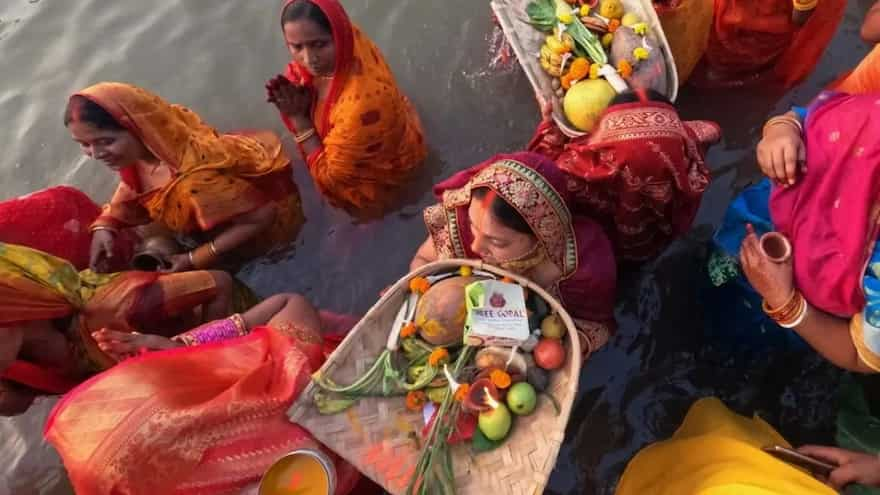
Living away from the home I grew up in and watching Chhath pass on very quietly at my in-laws’ house has made me notice how deeply this festival is shared by the people who love it. For generations, Chhath Puja has been rooted in the riverbanks of Bihar, Jharkhand, and eastern Uttar Pradesh, yet it has never really stayed bound to a map. As families have moved across the country for work and for other purposes, they have packed a piece of that familiar rhythm with them into their suitcases. At present, the same evening and morning arghyas unfold beside makeshift ponds in Delhi as well as Bengaluru, and along crowded beaches in Mumbai, where strangers from all over come together to recreate that same warmth of home.
It has travelled even farther than that. Across the United States, the United Kingdom, Mauritius, Australia, and Singapore, Indian communities gather every autumn around lakes and parks, determined not to let distance keep them from being connected to their roots.
The backdrop may change, from the wide, misty stretch of the Ganga to a small suburban pond thousands of miles away, but the heart of the ritual is what refuses to change. Wherever people stand facing the sun, the bamboo daura, the tall stalks of sugarcane, the humming of folk songs, and the specific aroma of thekua still carry the same feeling of being at home.
 (Credits: Pexels)
The Memories Of Chhath I Carry With Me
When I look back at why Chhath Puja still tugs at me so intensely after marriage, I realise it was never really about the rituals on their own. Growing up, we seldom spoke about love out loud; rather, it lived in the unspoken rhythm of those two days. It was there in the quiet fondness of waking before dawn, in the way the family gathered around the dining table to feed the fasting women, and in the pleasant certainty of being a child in a house that is full of adults holding the world together for you.
Stepping into a married life where Chhath is not observed has forced me to confront a subtler truth: growing up often means leaving behind the spaces where you just belonged without having to try. When you are no longer standing beside that plastered chulha or walking down to the Ganga ghat with your family, you realise that what you are actually missing is not just a festival, it is a version of yourself that lived only within that shared, familiar warmth.
A familiar fragrance can bring back an entire afternoon, the people and conversations that seemed to go on forever. Chhath Puja carries all of that for me. The aroma of desi ghee pooris, thekua and kasar is no longer just festive food for me. They are reminders of a home that gets busier with every passing day of the festival. Every year, as Chhath returns, so does the longing for those familiar days, for the warmth of the crowded house and for the people who made the festival feel like home for me.




