THE
FESTIVAL OF Maghe Sankranti
or Maghi is one of great significance
for Nepali people. While there is a fair
bit of folklore surrounding the festival
and its celebration, there are two
narratives that recur most frequently.
One of these
tales is of a Bhadgaun (present-day
Bhaktapur) trader, who dealt in sesame
seeds. The trader realised that his
stock hadn't run low despite a period of
very brisk business. With a sense of
wonder, he went through the heap of
sesame in his storehouse and discovered
at the very bottom, an idol of Lord
Vishnu. Vishnu is therefore known as
"Til Madhav" here, and it is believed
that worshipping the deity brings
prosperity and abundance.
The second bit
of lore associated with the festival is
that Bhishma Pitamaha's demise occurred
on this day, and so, whosoever passes
away on Sankranti will experience
salvation, transcending the cycle of
rebirth.
There are
several similarities in how Nepali
people from different communities
celebrate Sankranti, including
performing ritual purification baths in
the morning in holy water bodies,
getting together with family and
friends, and feasting on specific
dishes. However, there are some aspects
unique to each community as well.
For instance,
the Tharu community considers Maghi
their new year, and celebrations span
several days, if not weeks. Alcohol is
brewed at home for the festive spread,
and pork, boar meat and poultry are
arranged for the entire community.
Participating in traditional songs,
dances and customs are a chance for the
people to come together and enliven
their shared heritage.
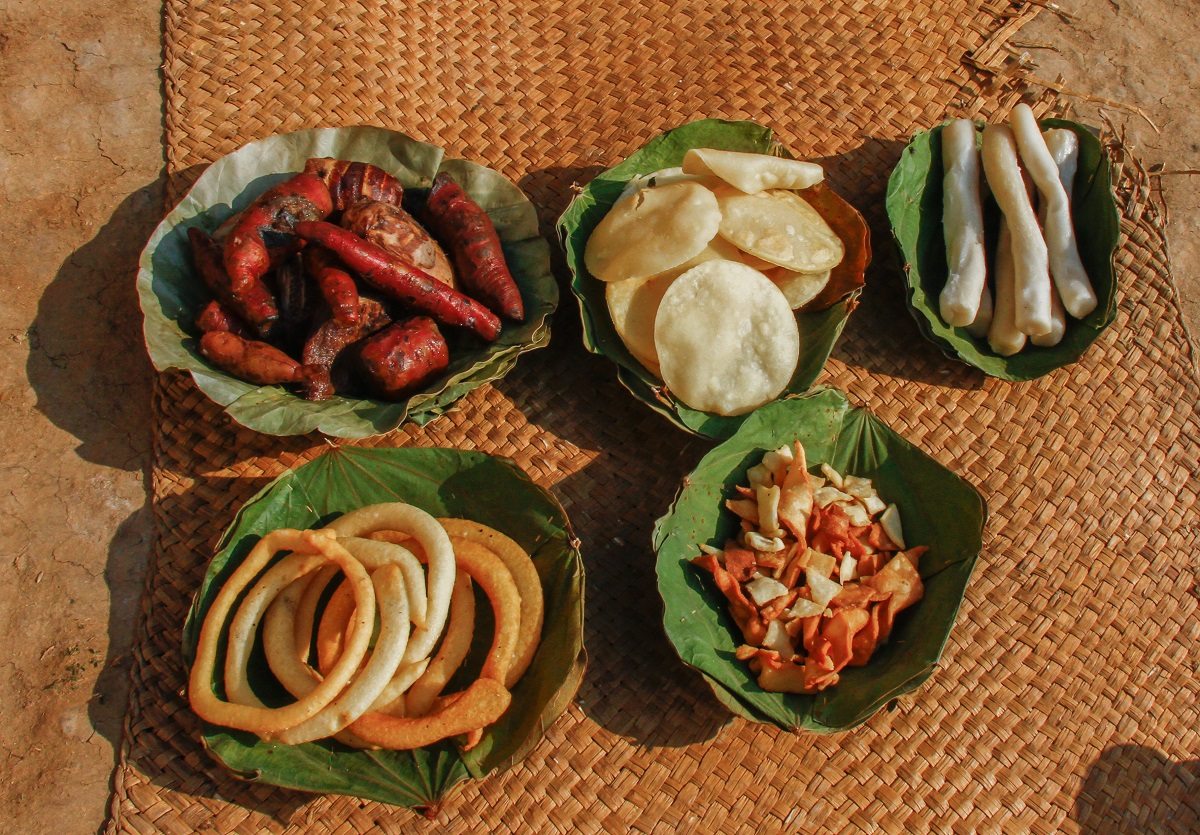
On the other
hand, the Newari people (of the
Kathmandu Valley) refer to Sankranti as
"Ghyo/Ghi'u Chaku Tarul" day or
"Ghyo/Ghi'u Chaku Sanyu", after the food
that is consumed on the festival. This
includes yam/cassava (tarul; often
prepared with a special spinach variety
known as "patne palungo"), ghee
(ghyo/ghi'u), chaku (a sweet made with
concentrated sugarcane juice, jaggery,
ghee and nuts), til ko laddu (sesame
candy/brown sesame seed fudge), sweet
potatoes etc.
Chaku may be
served with yam and ghee, or as a
filling in yomari (steamed rice flour
dumplings). In its syrupy state as
refined molasses, chaku is also mixed
with sesame seeds (of any colour) to
prepare "tilauri" or "kalo til ko
laddoo".
A festive
staple that is found in Newari
households on Sankranti day is samay
baji. Samay baji is a thali laden with
several standard items, including
chataamari (rice crepe), beaten rice
(baji or chiura), woh (fluffy pan-fried
patties or pancakes, made of lentils; if
the patty is deep fried, then it is
known as "maas ko baara"), spiced and
grilled buffalo meat (chhwela or
choila), fried boiled egg (andar), fried
black soybeans (bhatamaas), spicy potato
salad (aalu-wala), finely cut ginger
(palu), boiled beans mixed with spices
(bodi ko achar), green leaves (saag),
and ayla (an indigenous liquor). A
hot-and-sour vegetable pickle (radish,
carrot, onion, potatoes, peas, and a
Nepali berry known as
lapsi/aamli/Nepalese hog plum) finishes
off the platter.
OTHER
ITERATIONS
Sri
Lanka — Thai Pongal
In Sri Lanka,
the harvest festival is dedicated to the
sun god, Suriyapakaran. The lore around
the festival states that Shiva had asked
Nandi, the bull, to convey to the people
on earth that they must eat rice once a
month and take an oil bath daily. A
confused Nandi mixed up the
instructions, causing people to eat
daily and take an oil bath monthly. An
annoyed Shiva punished Nandi by sending
him to live on earth, to help people as
they toiled in the paddy fields.
To celebrate
Thai Pongal, kolams are drawn before
every house. Milk, rice, jaggery and
sugarcane syrup are boiled together, and
the pudding is offered to Suriyapakaran,
then shared by the family. Later, the
cattle that plough the fields are washed
and On the second day, the oxen (Mattu)
that assist the farmers in the rice
fields are washed and bedecked with
straw garlands.
Sindh
(Pakistan) — Lal Loi,
Tirmoori
In Pakistan's
Sindh province, sesame seeds (til) are
made into laddoo and chikki (laaee) and
distributed among family members on the
occasion of Tirmoori. A few pieces of
radish (moori) may also be given to
one's relatives. Tirmoori is sometimes
referred to as Utraan, and is celebrated
by flying kites.
Lal Loi, on
the other hand, is observed in a similar
fashion as Lohri in Punjab. Ber,
carrots, sesame seeds and revdi (a
crunchy candy made of sugar and sesame)
are cast into the bonfire as sacred
offerings. Prashad is shared in the form
of borinda (akin to the tilgul
laddoo).
Bangladesh
— Shakrain
Shakrain marks
the last day of the Bangla month of
Poush. The festival has two main
features in Bangladesh: pitha
(pancakes/fritters) made with new rice,
and the flying of kites. Dhaka comes
alive with colour and festivity during
Shakrain.
***
Visit
the Slurrp website or
download the app
for recipes, meal plans and
kitchen
hacks.
Think
someone you know might like this
newsletter? Forward this email.
And if you received this
newsletter from a kindly soul,
do consider hitting
the subscribe
button.